Insights
EV charger IoT SIM connectivity: a practical acceptance test
An EV charger is not ready for a cellular connectivity rollout merely because its modem registers on a network. The charger must reach its management system, establish the expected OCPP session, report a controlled test transaction and recover after an interruption. This checklist separates those outcomes before a buyer selects a Global IoT SIM plan.
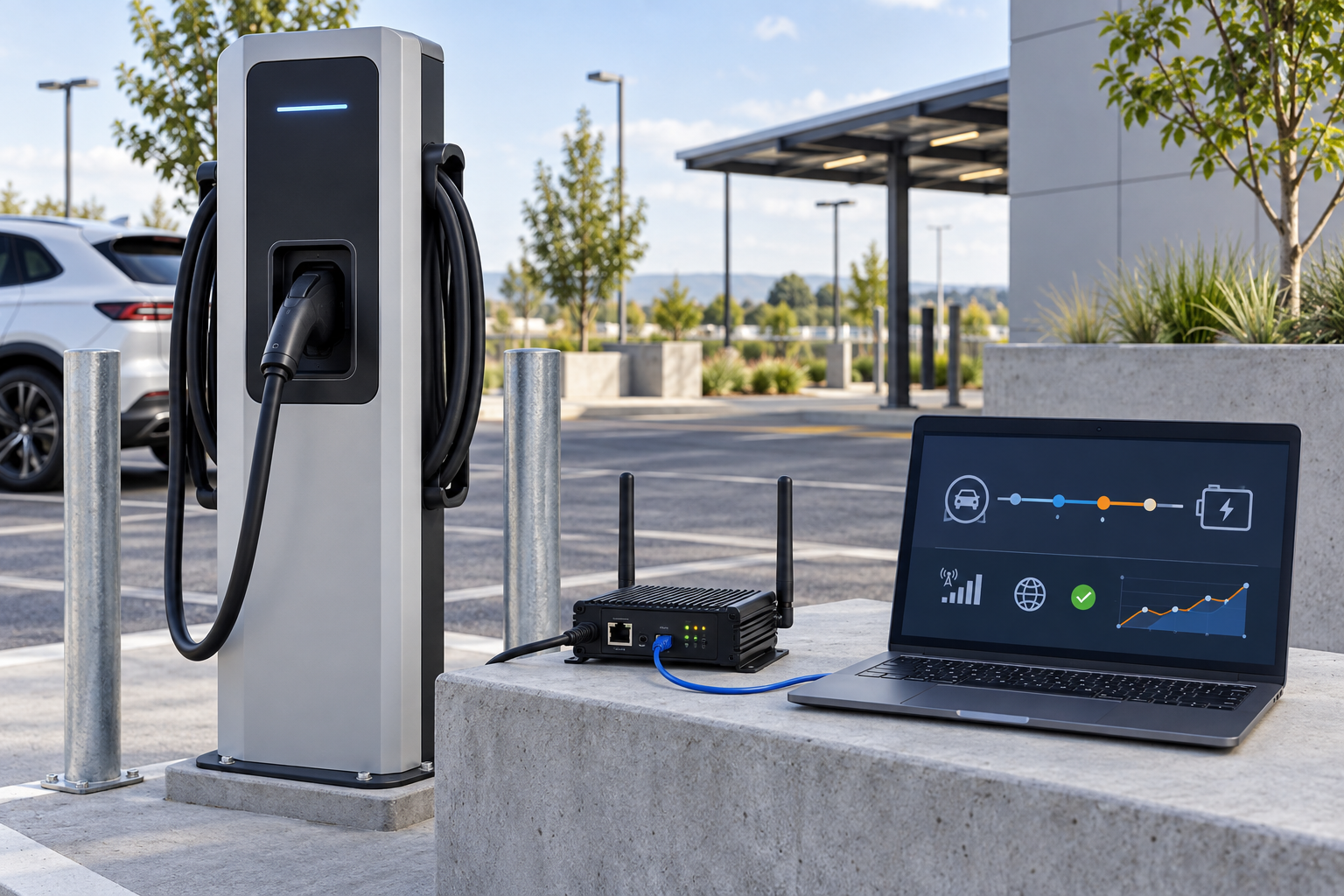
Define the charging-system test boundary
Record the charger model, modem, firmware, country, installation position, backend endpoint and OCPP version. Ask the charging-platform owner which test environment and transaction procedure are approved. A cellular SIM can provide the IP path, but the charger firmware, backend and authorization flow determine what the operator sees.
Separate modem registration, data-session reachability, TLS or endpoint connection, OCPP boot or heartbeat behavior and a confirmed test transaction. A signal icon is only one observation and cannot prove that the charging backend received the expected message.
Test interruption and recovery as separate cases
Run a baseline on the intended site, then test a controlled cellular interruption and a backend interruption according to the operator's procedure. Record the last known charger state, reconnection observation, heartbeat or status message, transaction state and any manual action. Do not test a live customer's charging session without approval.
OCPP capabilities such as remote management and transaction handling still depend on the actual implementation and backend configuration. Treat recovery time as a measured observation for that configuration, not as a universal connectivity guarantee.
Include identity, access and usage in the handover
Use one record per charger: device identity, SIM or eSIM reference held privately, firmware, country, APN, endpoint owner, certificate owner, installer role and support contact. NIST's capability catalog makes identity, logical access, software update and state awareness useful questions for the handover. Keep credentials out of shared evidence.
Measure routine telemetry, heartbeats, remote commands, diagnostics and firmware-update traffic separately. Confirm the plan's accounting units and usage visibility with the proposed service. Request a project quote when locations, device variants, countries, eSIM provisioning or backend coordination make a catalog allowance insufficient to describe the deployment.
Frequently asked questions
Does OCPP compatibility prove that an IoT SIM will work with a charger?
No. OCPP describes communication between the charger and its backend. Confirm the charger modem, bands, APN, endpoint security, firmware and proposed SIM arrangement together.
Is a strong signal enough to approve an EV charger deployment?
No. Test the data session, backend connection, OCPP behavior, controlled transaction and recovery on the actual site and hardware.
When should an EV charging operator request a project quote?
Request one for multiple countries or charger variants, coordinated eSIM provisioning, defined usage reporting, backend integration or a phased pilot with specific acceptance evidence.
Official references
Related reading
Share your charger models, countries, backend requirements and pilot criteria with Quanqiu IoT to discuss a scoped Global IoT SIM or eSIM project.
Discuss your project