Insights
Physical SIM vs eSIM for IoT: a deployment decision framework
Physical SIM and eSIM are deployment choices, not interchangeable marketing labels. Choose after checking the device's actual eUICC and profile workflow, who controls provisioning, how a replacement is handled and what the project needs in the field. This framework helps buyers compare Global IoT SIM options without assuming that every eSIM device supports the same remote management model.
Start with the device and installation reality
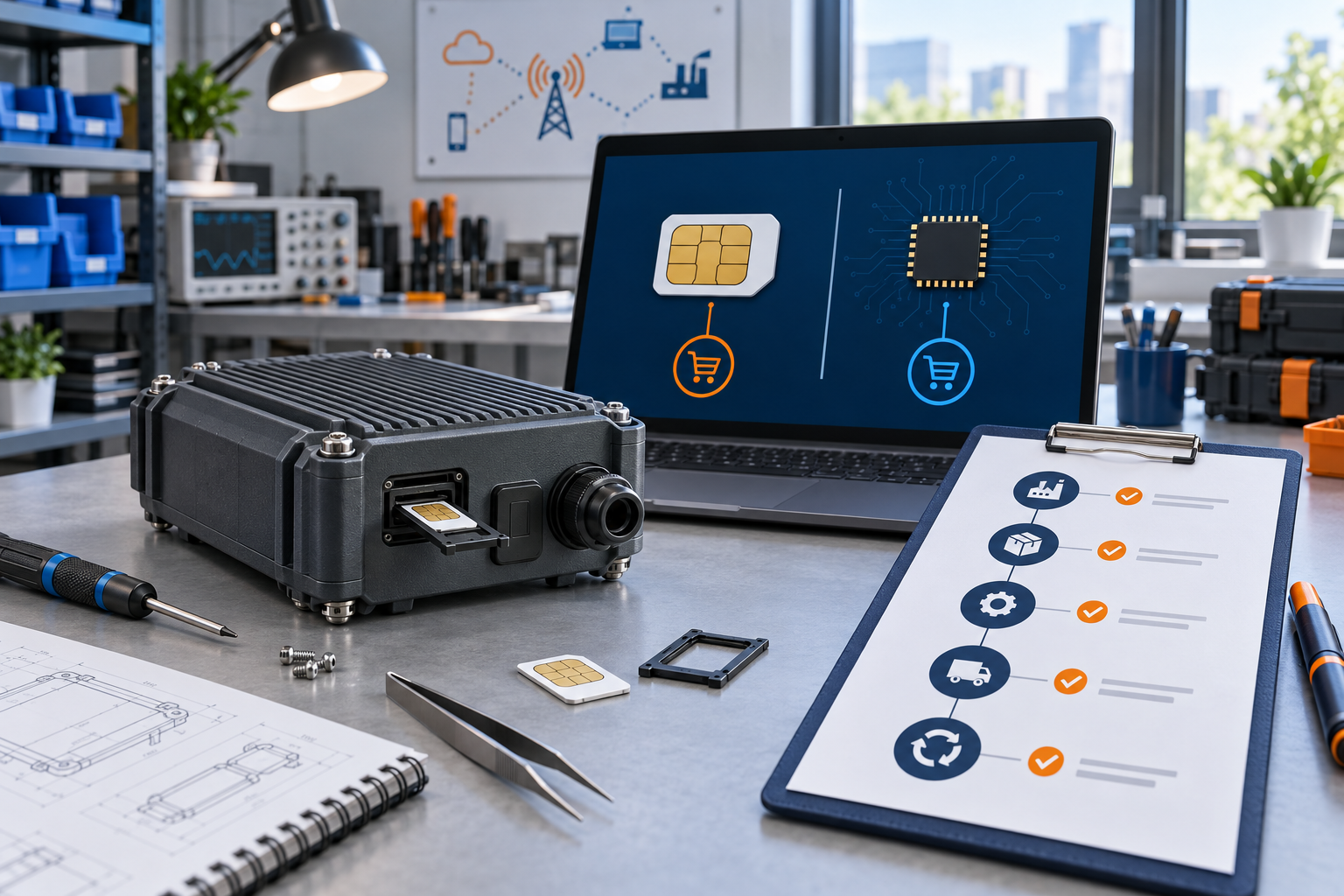
For a physical SIM, confirm the form factor, access after installation, environmental protection, replacement method and whether the device can be opened without invalidating the installation process. For eSIM, confirm the actual eUICC, supported profile operations, device-side software and the remote manager relationship. Do not infer eSIM capability from a product page that only says cellular or dual-SIM.
The GSMA index shows that eSIM IoT specifications and test versions have status and version distinctions. Record the exact device and specification claims that the vendor can substantiate before treating eSIM as a deployment feature.
Assign provisioning and lifecycle ownership
Ask who requests a profile, authorizes installation, changes or disables it, monitors state and handles a device that is offline. Define the handover between OEM, integrator, connectivity supplier, operator and end customer. A CMP may provide useful lifecycle visibility, but its actual permissions, API and alert behavior must be confirmed for the proposed service.
For remote or sealed devices, eSIM may reduce physical intervention, but it does not remove the need for identity, authorization, rollback and support procedures. NIST's catalog is useful for turning those risks into device and access questions.
Use a pilot to test the full path
Test activation or profile installation, first registration, APN and data session, application reachability, profile change or replacement if in scope, and recovery after a failed or interrupted operation. Run the cases on the intended country, hardware revision and firmware. Keep a physical-SIM path in the comparison when field replacement is important.
Bring quantities, countries, device models, installation life, expected traffic, eSIM requirements and pilot evidence to the buying discussion. Catalog pricing can be a starting point; request a project quote when provisioning ownership, device variants or lifecycle coordination are material to the outcome.
Frequently asked questions
Is eSIM always better than a physical SIM for IoT?
No. The better choice depends on device design, field access, profile workflow, ownership, lifecycle requirements and verified compatibility.
Does eSIM automatically provide multi-network or multi-operator service?
No. Profile capability, commercial arrangement, device support and network policy must be confirmed separately.
What should an eSIM inquiry include?
Include eUICC/device details, countries, quantities, profile or provisioning needs, owners of lifecycle actions, traffic, pilot cases and required CMP or API scope.
Official references
Related reading
Share your device design, deployment countries and provisioning requirements with Quanqiu IoT to compare physical SIM and eSIM paths.
Discuss your project